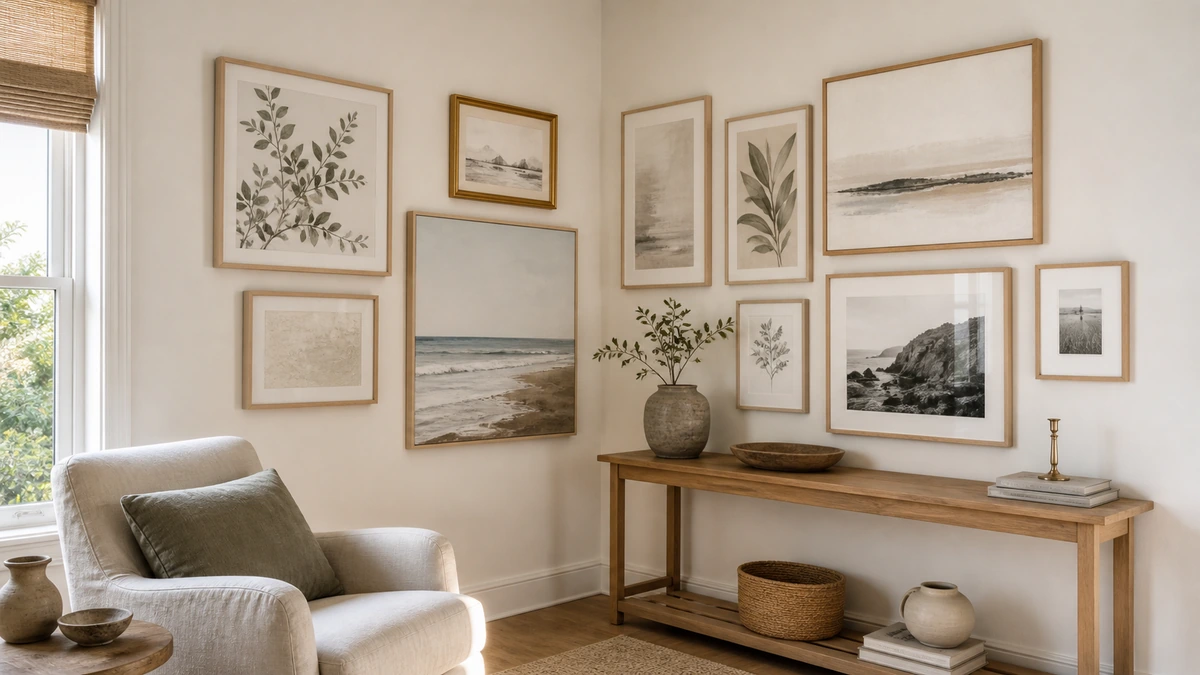
9 Corner Gallery Wall Ideas for a Calm Coastal Home
This post contains affiliate links. As an Amazon Associate I earn from qualifying purchases.
Got an inside corner that looks unfinished from every angle? You do not need to cover both walls with frames to fix it. Choose one clear layout, repeat one or two visual details, and leave enough breathing room at the turn.
These nine corner gallery wall ideas show where to begin, how to make two walls feel connected, and how to keep the result light enough for a calm coastal home. Start with the planning steps, then choose the idea that matches the room you already have.
How to plan a corner gallery wall without making it feel busy
Before you make holes in the wall, cut paper shapes for the frames and tape them up. This lets you test the turn of the corner, the view from the doorway, and the space needed around furniture. It also makes it easier to spot a layout that is too dense.
Use the largest piece as the visual anchor. Then place smaller pieces around it, keeping one repeated detail—such as the same mat color, frame finish, or subject—to connect the two walls. A corner can handle variety, but it still needs a reason for the pieces to belong together.
Check the wall type and the hanging instructions for the hardware you plan to use. Keep frames clear of doors, switches, and furniture that needs to move. If the layout is going above a chair or console, stand back and check the sightline before you finalize it.
Nine corner gallery wall ideas
1. Wrap the gallery across both walls
Treat the inside corner as the hinge of the arrangement. Let the display begin on the wider wall, continue around the turn, and finish with one or two smaller pieces on the shorter wall. Matching spacing matters more here than matching frame sizes.
This works especially well in a living room where the corner is visible from the sofa and the entry. Keep the art on both sides at a similar height so the corner reads as one display instead of two unrelated walls.
Sheffield Home 9 Piece Gallery Wall Frame Set, 11×14 Inch, Light Natural
This nine-piece set is listed with a wall template, pre-attached hanging hardware, mats, art prints, and protective glass. The Light Natural finish can give a warm-white wall a little structure without making the corner feel dark.
Check the latest price on Amazon.
2. Build a reading-nook corner around one tall frame
Place a chair, floor lamp, or small side table near the corner, then use the wall above it for a narrow vertical arrangement. One taller frame gives the eye a starting point; two smaller pieces can step toward the adjoining wall.
Keep the lower edge of the display comfortably above the furniture. A quiet reading nook usually benefits from fewer, larger images rather than a crowded collection of tiny pieces. Try a shoreline photograph, a soft botanical drawing, or a simple black-and-white image with plenty of open space.
3. Put a shallow wall-mounted shelf on one side
Not every corner needs framed art on both walls. A small shelf on one side can hold a few picture frames, a small vessel, or one plant, while the other wall stays mostly open. The empty wall becomes part of the composition rather than a problem to solve.
This is a useful approach for an entryway or a compact dining nook. Keep the shelf visually light and edit the objects so the corner has one focal point instead of a collection of unrelated accents.
Umbra Montage Floating Wall Shelf, Bent-Wood Wall Mount Decor, Natural
The listing describes natural bent-wood construction, horizontal or vertical mounting, and a total weight capacity of 15 pounds. Treat it as an alternative wall-mounted display for one side of the corner, and check the wall type, hardware directions, and planned load before installation.
Check the latest price on Amazon.
4. Follow the direction of a stair landing
At the top or bottom of stairs, a gallery wall can make a transition space feel intentional. Arrange the pieces so the outer edge follows the movement of the stairs, while the frames nearest the corner create a stable vertical line.
Paper templates are particularly helpful here. View the arrangement from both levels before hanging anything, and keep the display clear of the path people use to move through the landing.
5. Use a tall stack in a small apartment
When floor space is limited, build upward instead of spreading the display across the whole corner. A vertical stack of three to five frames can add personality without competing with a narrow console, a coat rack, or a small dining table.
Choose one frame color and let the artwork provide the variation. Pale blue, faded green, warm white, and charcoal can create a coastal feeling without turning the corner into a themed display.
6. Make a measured grid for a calm living room
A simple grid is a good choice when you want the wall to feel settled and orderly. Use equal-size frames, align the outer edges, and let the corner interrupt the grid only if the room gives you enough width on both sides.
For a nine-frame arrangement, lay the pieces on the floor first and photograph the plan. The image gives you a quick record of the spacing before you move anything to the wall. Use family photos, travel images, or prints with a shared background color so the grid does not feel flat.
7. Mix vintage finishes with pale mats
Vintage-inspired gallery wall ideas do not have to feel heavy. Start with one warm gold or brass-toned frame, add light mats, and balance the finish with pale oak, ivory, or a slim black frame. The contrast gives the corner character while the mats keep the artwork readable.
This approach suits a dining corner, bedroom, or hallway where a little warmth can make the space feel collected. Keep the artwork simpler when the frames are more decorative; that balance prevents the corner from becoming visually noisy.
Kate and Laurel Adlynn Traditional Picture Frame Set, Set of 5, Varying Sizes, Vintage Gold, Classic Wall Frame Set Collection with Hanging Template for Gallery Wall Picture Frame Display
This five-piece set is listed in varying sizes with a Vintage Gold finish, soft white mats, a hanging template, and hardware for vertical or horizontal display. It can help create a warm vintage lane within a coastal palette, especially when the surrounding art stays light and restrained.
Check the latest price on Amazon.
8. Let botanical prints soften an awkward corner
If the corner feels too sharp, use artwork with organic shapes. Botanical studies, olive branches, grasses, and loose shoreline sketches can soften the geometry without adding more furniture.
Keep the greens muted and repeat one pale tone in the mats or frames. A small plant on the floor or a woven basket below the display can echo the artwork, but leave some wall visible so the corner still has room to breathe.
9. Create a coastal photo wall with one quiet color story
A corner photo gallery wall can feel personal without looking random. Gather images with a similar light level—sun-washed beaches, pale architecture, blue-gray water, or simple details from everyday life—and print them in a few consistent sizes.
Use one side of the corner for the strongest image and let the other side become a softer continuation. If every image has a different color temperature, the corner may feel disconnected. A shared blue, sand, or warm-white note is enough to bring the set together.
A calm coastal palette for framed art
The easiest way to keep a gallery wall coastal is to edit the palette before you edit the frame count. Warm white makes a useful background. Pale oak and light natural finishes add texture. Sea-glass blue, sand, faded green, and muted brass can supply the color without relying on obvious nautical symbols.
You can carry the same restrained approach through the rest of the room with these 9 coastal living room ideas for a calm, collected space. Keep the gallery wall as the visual detail and allow the larger furniture pieces to stay quiet.
FAQ
How many frames should go in a corner gallery wall?
There is no required number. Start with the wall width, furniture, and the artwork you already own. Three to five pieces can define a small nook, while a larger wrap-around wall may support a fuller arrangement. Paper templates will show you when the display feels complete.
How do I make two walls feel connected?
Repeat one element across the corner: the frame finish, mat color, artwork subject, or spacing. You do not need every piece to match. One repeated detail is often enough to make the two walls read as one composition.
Can I try these ideas in a rental?
Start with paper templates and check the wall surface before choosing any hanging method. Follow the hardware instructions and the property rules; do not assume that one type of adhesive or hook suits every wall. A leaning frame arrangement or a shelf-free layout can also give you a way to test the look before committing to installation.
Your next step
Choose one corner and one of the nine layouts. Trace the frame shapes on paper, tape them up, and live with the arrangement for a day. If the corner feels balanced from the doorway, the sofa, and the room’s main seat, you have a clear plan to install.